Showing posts with label Olympics. Show all posts

Monday, September 2, 2013

Athletic Development: Collegiate Model vs. Nationalism or Apprenticeships


The beginning of the college sports season is a good moment to think about college sports in a broader framework. In particular hows it exists as a model of development that competes with two alternatives--nationalist & apprenticeship.

Achieving athletic excellence takes years of commitment and is a high risk career aspiration. I want to examine three social models that have developed to further individuals on the path of becoming elite athletes. These development models emerged over time and have morphed often creating hybrids. For this discussion, I will call them the nationalist, apprenticeship and collegiate models. China, Europe and the United States epitomize them.

I want to focus on the life outcomes for the individual who sets out on these development paths. I will contend that the American model with its emphasis upon college as a final or intermediate stop for many aspiring athletes leaves the individual with much brighter long-term life prospects than an apprentice or nationalist based recruiting and training model.


A couple points to remember:

1)   The odds against succeeding as an elite athlete are very high—maybe 60,000 to 1 against a 15 year old athlete becoming a professional in the United States.

2)   Achieving elite status takes immense investment not just from the athlete but from other sources in training, infrastructure, coaching and arenas of play.

3)   Most aspiring athletes fail and are ejected from or quit the developmental systems. While sports have different peaking ages especially in the early development sports such as diving or gymnastics, the vast majority of aspirant athletes are “retired” by age 23.

4)  Athletic development begins with self-selection usually by parents + children, but quickly links to networks of scouting, recruiting and investing to push athletes along.

Athletics beckons folks as a domain of fun, achievement and reward. In some societies, it offers jackpot returns as professional players or as elite national team players in the Olympics and World Championships. The jackpots exist in terms of money from team salaries or sponsorships either as a professional or as a national or independent player. Successful elite athletes can earn glory and make good livings, become rich and be celebrities, but we need to remember  these odds resemble those of a lottery.

Nationalist

The easiest systems to identify are the nationalist systems that categorize sport as an extension of national identity and a tool of soft power. The Olympics epitomize this. The classic examples are  Germany or China’s huge investments in 1936 and 2008 Olympics to create center stages for states to deploy sports to strategically enhance their prestige. Olympic medal wars that media avidly followed during the cold war Olympics transformed into surrogates for claims of national superiority. 

The ultimate example of states deploying sports as a national prestige enterprise still remains East Germany. It forged a thirty-year athletic factory that produced numerous Olympic and World championships far beyond what their wealth or population could suggest. The state sponsored nation wide athletic clubs and recruited promising athletes at an early age. They segregated these young athletes into schools with intense training regimes augmented with rigorous systems of performance enhancing drugs. This resulted in Valkyrie women who dominated swimming and track and field for twenty years. It was followed by forty years of illness and side-effects to the men and women subjected to the science experiments and routines of drug usage.
 
In the nationalist model states scour the society and sponsor state sports clubs, teams and schools from age five and six. The modern Chinese model of juguo tizhi or "whole-nation sports system" represents the most comprehensive modern variation.  Sports authorities scout and recruit the best young athletes. The state then invests heavily in them usually from as early as age 6 and on. Usually the athletes leave their parents and go to separate schools where the children focus upon sports and may get the equivalent of a low-level high school education.

The states ruthlessly cull athletes who do not measure up. This results in tracking and sometimes moving recruited athletes off to physical education programs or simply out of the program. The athletes are segregated from society, trained as athletes and barely as students and most end up on the streets with little real education or life possibilities.

The stars are feted and pushed relentlessly as well as culled if they do not succeed. The celebrity and status come at the cost of significant political constraints upon conformity for the nationalist athletic has to represent the ideals of the country. Generations of athletes who have escaped national systems can understand the modern travels of China's Li Na who resents how she was forced to play tennis as a way to escape and now has left the system only to find herself covered, praised and excoriated for every deviation from the government's norms. Even then many world champions or Olympic competitors end up retired by age 24 with no education or skills to speak of. Often they fade back into the woodwork with low life chances unless picked up to help train the next generation.

Apprenticeship

The apprentice model starts like a free market model. No central mechanism controls or invests in the athletes. Individual kid’s talent and desire as well as parental influence pave the sports route. Parents matter a lot when they invest in and push the children.

Many kids find the sports on the street or at local clubs or schools. They end up playing in diverse social places and migrate slowly into local clubs. The entry-level costs are very low, and lots of kids and families partake here. The market competition gradually weeds out kids and parents in three ways. First, the ones who do not develop quickly end up playing in recreational leagues that are fun and enjoyable but have no future paths. Second, some will get advantages because parents will invest more time and resources in them getting them training and performance that will be noticed. Third, a group of promising kids will be seen by scouts or teachers and join a network that has some resources, teachers and the possibility of a path up and out through sports.

In apprentice systems that dominate European sports especially soccer, clubs scout extensively and recruit young players into their feeder clubs and then leagues. These young players become very young professionals by American standards getting food, lodging travel and training and playing time plus stipend by age 14-17.

Athletes move up in the system through different degrees of play and coaching. A severe culling can occur here as competition increases. In many areas, international players from Africa, Latin America and the United States end up playing in the systems. The competition gets very intense among very young professionals who parse out to many different levels of professional teams and leagues. While soccer typifies the model it is the substructure of most team sports such as volleyball or crew or basketball.

The apprentice system gives very little weight to non-sport or formal education. Because so many players come from the working class or below, few have families that push formal education. Some clubs make erstwhile efforts to encourage education, but once on the road and training for elite status, formal education falls by the wayside.

This has the advantage of culling talent earlier and creating immense number of hours and expertise earlier. Apprentice systems produce higher quality younger players, but trade off formal education and long term life changes. When players leave or are left by the apprentice system or clubs, they have no real formal education and no occupational training except their sport. You can see this in the USA national soccer team coach Jurgen Klinsmann’s announced preference for recruiting young Americans raised and trained in Germany rather than those who actually go to college.

The cast offs of the system have few real career options or training for higher education and end up at 22 ill prepared to advance. The results are large numbers of failed apprentices with few life possibilities or skills beyond finding some place in the existing sports system. The professionals in such systems can have longer careers because of the higher number and gradation of leagues. So a class of travelled second level elite players inhabit the worlds of international apprentice based soccer but also basketball, volleyball, cricket and similar sports sustained by apprentices and sponsored European corporate teams or professional teams. But the vast majority of ambitious athletes who commit to the system end up retired early without formal education and limited life possibilities.

Collegiate

Here the often-maligned American collegiate system can shine. Most American elite athletes channel through higher education. Young athletes in most sports aspire to college scholarships rather than going professional. Even those seeking to be professionals usually go through college to get there.

This collegiate model possesses a distinct advantage for the athletes. The athletes filter into different divisions of elite play, but still get to compete in the sport they love. They find appropriate levels of competition and experience the joys, challenges, problems and dimensions of intense athletic competition but also college education. They can graduate with a higher education degree that opens up a much higher level of work paths and higher income.

The American system can accommodate strong Olympic and national team feeders. In most sports the ultra-elite of American college athletes can go on to be on national or Olympic teams or take time off to compete. In addition, many sports such as gymnastics, swimming or diving and track and field and end up offering scholarships to players after their Olympic competition possibilities have peaked. 

At the same time wannabe Olympians or professionals need not go this route. Large numbers of swimmers, skiers, gymnasts, tennis or golf players take independent parent or sponsor financed tracks to compete and forgo college. This happens exclusively in many winter sports such as various forms of skiing and X sports.  Many top golf and tennis or soccer players never end up in college and bypass directly for professional leagues at a very early age. Similarly the major-league baseball systems provides a European club style developmental track for high school graduates, but it ensures they got through high school first.

There are more rational ways to get to colleges. But given a choice, I would rather have an aspiring athlete aiming for a college scholarship rather than aiming to enter a professional apprentice track at age 14. At college they have the chance to develop as athletics but also develop as persons and acquire deeper social and intellectual capital. This makes it makes it a much richer and more defensible developmental approach for athletes.  The college approach has profound strengths for the development of the individual person given the low probability of any elite athlete of making a career out of it. 

International student athletes who come to the United States provide some insights. I remember one international rower telling me, “I can come here and perfect my rowing and get a degree in accounting. At home I would never get a chance to go to school given my national team commitments.”  Another mentioned, “at home I had a choice. Play and take the chances to become a professional or quit and go to school, if I could afford it. I came here, played for five years, got a good degree and realized I would never be a pro.”

Meeting and working with international athletes and students changed my view of the American system with its focus on helping athletes become students; its capacity for people to compete at multiple level; and the outcome of elite athlete aspirants who end up with degrees and life chances beyond their sports.

To me as an educator the real success and advantage of the American college athletics systems lies in the outcomes for the person. When it works, and it works well the vast majority of the times, 90,000 athletes each year graduate with college degrees and have experienced four years of elite play at their appropriate levels; have had the chance to gain an education and mature with peers and in the classroom; have learned to carry themselves as a person and student as well as an athlete. Their life chances and callings remain far more open and challenging than the young athletes who are retired by age 23 in the nationalist or apprentice based systems.


Friday, August 3, 2012

First Fan: The Presidency, Obama & Politics meets Sports

The Presidential election is heating up, and President Obama is burnishing his credentials as First Fan. He has called Olympic swimmer Michael Phelps, the American gymnastics team and complimented them on winning gold medals and representing America in the Olympics. He tweets well wishes and congratulations daily to American athletes. As Phelps said, the calls were "pretty cool." Last month he thanked Boston for trading the wonderful Kevin Youklis to his beloved Chicago White Sox. Of course the Romney campaign attacked him for this, but it's not clear Mitt Romney could root for a sports team even if he tried, except for maybe his wife's horse dancing, sorry, I mean dressage. But a campaign and Olympic medals provide a good nexus to remember why whoever is President becomes de facto First Fan which is an important constitutional position. 

The Constitution separates Church and State. The Constitution does not separate sport and state. Since sport is one of America's civil religions, the President must assume a strong role as First Fan to preside over the liturgy of American sport.


William Howard Taft threw out the first pitch in 1910 of the baseball season and started an American tradition of President as First-Fan. He loved sports, broke tradition and set a strong precedent of connecting sport and the Presidency. Taft aligned himself and the Presidency with baseball and sanctioned the sport as America's past-time.

Long before Taft threw out the first ball of the season, Ulysses Grant had met with the very first professional team the Cincinnati Red Legs and Theodore Roosevelt had met with the Yankees who urged him to run again.  Ronald Reagan was a huge sports fan and began the modern era tradition of the  First Fan regularly inviting World Series winners to the White House. Later Reagan invited the  NBA winners. President Richard Nixon worshipped sports, played football in college and got so wrapped up in sports that he even called in a play to coach George Allen of the Washington Redskins during the Super Bowl.

Obama fits  naturally into a long line of President as First Fan. Some presidents made no sense as First-Fan, and the persona never fit like Jimmy Carter or Lyndon Johnson, but most American Presidents loved sports and enjoyed the connection. In a typical two week period two years ago President Obama played host to  the Duke men’s national championship basketball team. Later he met with the Connecticut women’s national basketball team. That afternoon he met with the US national soccer team and urged them on to victory

President Obama plays basketball to relax; he fills out NCAA basketball brackets in full and can explain on national TV why he picked which team; he can actually get the ball over the plate when he throws out the first pitch for the Nationals or the All Star game. When he wooed Michelle, Michelle's family tested his character in a basketball game. He models how to root for his home team but still respect the sport and other teams.

Many Americans relate to athletic teams as obsessively and passionately as to a religion, and the Presidency has evolved into First-Fan who presides over mixed religious, I mean sports, affiliations. The President tries to embody the spirit of sport and competition and excellence and community that freights American sport. He sanctifies the activity by going out to the games and ritually throwing out the first pitch. He sanctifies the winners and blesses Olympic or World Cup soldiers heading off to war.

The First Fan walks a tight rope. How do you root for your own team—Obama passionately supports the Chicago White Sox, wearing a grungy White Sox hat. (yet everything becomes politics and his detractors claim he really does not support them enough!) He threw out the pitch at the All Star Game wearing a White Sox jacket. When he threw out the first pitch at the Washington Nationals game he wore a White Sox hat with the Nationals' jacket.  GW Bush rooted for the team he once owned, the Texas Rangers, but still preside over all the sport. In my state of Washington, when the governor attends a Washington/Washington State game, she wears a scarf half knitted in UW colors and half in WSU colors. 

With Presidents Jimmy Carter or Lyndon Johnson, who could care a fig about competitive sports, it never feels quite real, kind of like Michael Dukakis pretending he knew something about the military. So the tight rope gives more than you might think. But being a real fan and suffering the pangs of loss and the joys of victory reveals a humanity and a willingness to be genuine when every incentive in politics is to not be genuine. Being a fan roots a President in a real local community and gives them a way to link with the rest of us.

Presidents meet with Olympic teams off to honor the country. They call Super Bowl victors and World Series winners. Part of it is pure self-interested politics. The President partakes in the reflected glory and status of the winners. But for the Presidents who care, they honor and acknowledge the excellence, the winners in competition. These Presidents know how sports competition embodies the American dream and ideal—hard work, skill, teamwork lead to excel and win. More interestingly each winning team, even the Yankees, has gone through the crucible of failure. Meeting with a team respects overcoming adversity to achieve. 

Our fetish for sports and athletics as a form of legitimacy and community makes it hard for some politicians. This hurts several classes of candidates. Republicans, more than Democrates, exploit the hidden coding of “effete” meaning weak and indecisive. They gravitate towards the tough sports like football,  Many politicians ends up as rootless and feel like carpet baggers. Someone like Richard Nixon loved sports, but had not been home in California for years. He  compensated by becoming a passionate Washington Red Skins fan. Others like Bobby Kennedy in NY or Hillary Clinton in NY simply have no real credibility in sports and lose the ability to use being a fan as proof of their local roots.

We give a pass to old guys like McCain and Reagan, but everyone knew Reagan was a fan and athletic, after all he chopped wood and played the Gipper in Knute Rockne. Right now I worry about the real costs to women. In one generation it won’t matter, but right now it strains a lot of imagination as Hillary Cinton demonstrated when she tried to be a Yankee fan.

In some ways better to be like LBJ and simply not care rather than feign interest. A non-fan trying to be a fan oozes insincerity, and being a fan is one of the few sincere things a politician can communicate. Especially as a politician aspires to higher office, being a fan carries costs because fans of other teams can hold it against him or her, but you stay loyal to your teams.

 It’s a lot like religion in American politics—a leader can be true to his or her own religion, but still preside over and respect the spiritual aspirations of all Americans. Mitt Romney is probably better off just staying away from the First Fan thing altogether during the race and let Obama make possible blunders with comments about Red Sox trades. On the other hand President Obama used his position as First-Fan to condemn the obsession with sports that could lead Penn State to hide child abuse to protect its football teams. At the risk of alienating Pennsylvania votes he reminded us all "But some things are just more important than sports. Making sure our kids are safe is more important than sports." 

The last thing about being First Fan: the President can model fan ethics. He can admire the sport; appreciate the skill and be a student of the game. He can  pick and root for teams. But he can demonstrate graciousness in defeat and honor in victory. He honors the sport and the success of committed and dedicated men and women. He honors them as athletes competitors and representing ideals that matter to Americans

Wednesday, August 1, 2012

Olympic Ideals Still Matter

Three billion human beings are watching the 2012 Olympic Games. They will view the beauty and power of the athletes and vicariously experience the anguish and glory of the athletes. They will root for and against, and sometimes have admiration ripped out of them by performances by athletes they did not support. Three billion people will celebrate human solidarity through Olympic ideals and practice.

At the same time a mini-industry of critics attack the Olympics for its inglorious hypocrisy and tawdry commercialism. The critics attack the endless sponsors; detractors bemoan the bribes and scandals about awarding Olympics and the gargantuan expenditures by countries to stage Olympics. Opponents decry the judging scandals and the political uses whether Hitler’s 1936 attempt at legitimacy, the boycotts of the Soviet Union and USA or the coming out party staged by China’s Olympics. Finally they will lament the win at all costs  mentality of individuals or nations that lead to chemical enhanced cheating whether muscle enhanced East German women or growth retarded Chinese divers or disgraced champions ranging from Marion Jones to Ben Johnson.

You know what? It does not matter. The scandals contribute to the greatness of the accomplishments because robust ideals fail all the time, but failure does not destroy their power.

Human ideals have many functions.
  •  They provide a vision to which people can aspire.
  •  A good ideal guides judgment.
  •  Ideals motivate people to organize attention and resources to pursue goals.
  •  They help humans to connect their lives to a project that individuals believe transcends their own individual selfishness.
  •  The best ideals provide moral resources to criticize actions and self correct in the name of getting better or closer to the idea.

Most worthy human endeavors are buttressed by ideals and grow through them even as people often fail to live up to them. Every professional practice such as law, engineering or medicine lives by this dynamic. A country like the United States exists as an imperfect pursuit of ideals.

Our own frailties and failures reinforce the importance and robustness of good ideals, and the Olympics represent very powerful and durable ideals. Yet the ideals live in the world we have created—London has six anti-aircraft sites to protect the games from terrorist and a huge drug testing apparatus employs hundreds of people. And yet we will watch because the ideals may be tarnished but remain beautiful.

The founding of the modern Olympics in 1896 had 214 athletes from 14 countries. Pierre de Coubertin who lead the effort believe fiercely that a reconstituted Olympics could reflect the “harmonious development of man,” and help build human peace just as the original Olympics built on a “truce” among the endlessly warring Greeks. Olympic virtues  would remind everyone that for humans “victory does not matter so much as the struggle.”

Here are six Olympic Ideals that remain true and robust in these imperfect games:

·      Olympians as Citizens
·      Competing from Desire and Love
·      Displaying Human Excellence
·      Merit and Inclusion
·      Ideals versus Imperfect Humanity
·      Human Solidarity

Olympians as Citizens:       Every athlete who reaches the Olympics achieves the pinnacle of achievement in their country or region. Being an OLYMPIAN brings great and deserved honor in itself that marks a person for life. An Olympian joins an elite citizenry of women and men who have worked hard, studied, competed and earned their position. An Olympian represents a form of human citizenship that everyone can celebrate.

Competing from Desire and Love:             98 percent of Olympians are not rich or extremely well off. Even state supported competitors live OK, but after the Olympics many will struggle to find a livelihood. Of the 36 Olympics sports, only basketball, tennis, soccer and sometimes volleyball  provide serious money as an occupation. Most Olympians hold their own jobs and scramble for sponsorship and support even as they compete in tournaments. These athletes carry on for the drive and joy of competing and for commitment to sports such as canoe, judo, shooting, trampoline, fencing or curling (woops, wrong season). These competitors pursue obscure sports with passion and skill because they love it and they enjoy winning and being the best. The Olympics vindicate and honor this pursuit.

Displaying Human Excellence                   The root meaning of athletics is struggle and achieving anything in life requires hard work, thinking and grappling with obstacles. The human condition is born in and lives through struggle; it embodies our challenge and nobility. DeCoubertin defended the morality of athletics and the Olympics upon the very French ideal that they epitomized triumphant struggle. Athletics paints a canvass where we watch and experience both the heart of struggle in competition but also the end product of superb achievement in physical and mental activities. People spend their entire lives to arrive at the Olympics, and the pinnacle offers the best that humanity can offer gathering in one place.

Merit and Inclusion             The Olympic ideal always sought inclusiveness “without discrimination” for all humans and countries to compete. This permitted self-criticism and gradually expanded to all the countries of the world but also expanded from men to women. Nonwestern sports such as judo and Taekwondo are now in competition. Nonwestern countries sponsor the games and regualry win medals. Often it meant not all athletes from their countries were the best of the best, but they represented the best of that country or region, and that was good enough. The best earn Olympic participation, and athletes in every part of the world can dream of being an Olympian.

Ideals versus Imperfect Humanity                        The critics are right, the Olympics are overly commercialized, can be distorted by politics and cost way too much, and people pursue them for mixed motives such as gaining endorsements or status in their own country. Right and so what? Humans have always been creatures of mixed motives, our very mixed motives and riven nature make the achievement of beauty and achievement in art, science, friendship and sports so remarkable. Very imperfect artists can create great art; great political achievements involve mixed motives and compromises; why should athletics be any different? The achievement through and despite our human frailties deserves respect and celebration.

Human solidarity                 For the original founders creating a liturgical stage for competition represented a means to a much deeper end--to encourage human solidarity. The Olympics for modern humanity as for ancient Greece can provide a sacramental space to celebrate the incarnation of our common and shared humanity. Like the achievements and methods of science, the achievements and method of sport transcend national and ethnic boundaries and permit us to honor and appreciate our common human embodiment and struggle.  The Olympic founders were deeply dedicated to the peace movement and believe athletics teaches that humans can compete and struggle other without hatred or becoming enemies.

In the first modern Olympics, they took the swimmers off the coast of Greece and dropped them in the Mediterranean Sea. The first winner claimed he was more concerned with keeping alive in the water than winning. That spirit still explains why the Olympic ideals matter.


Sunday, June 10, 2012

Maria Sharapova and the Dilemma of Beauty and Sport

Every girl or woman who plays sports knows the unfairness. No matter how skilled or talented, every female knows her appearance will be judged as she plays her sport. She may win, she may lose, but her looks and beauty will be assessed. No women enjoy this, some benefit from it, most resent it but all female athletes have to grapple with it. In the end the only way to silence the beauty obsession of the male gaze lies in triumph with skill. Maria Sharapova’s win at the French Open illustrates the dilemma in all its unfairness.

Maria Sharapova is a beautiful woman. Tall, blond, svelte muscled, cheek-bones, graceful and spirited. In 2004 at 17 she won Wimbledon and in four years had picked up three grand slams. She earns an estimated 22.5 million dollars a year in endorsements, the best-paid female athlete in the world. Yet she has not been ranked number 1 since 2008 and won no grand slams in the last 3 years. Her income towers over tennis players, male and female, far more highly ranked and often more skilled.

Players seethe believing correctly that her looks and personality factored more highly than her skill in her endorsements. This was not the confluence of beauty and dominance that Tiger Wood exploited. She played erratically and never really dominated the circuit, only reaching number one ranking 5 times.  She lived in the shadow of Serena Williams’ unearthly skill. She presented as the poster child for beauty mattering more than skill or talent in women’s sports.

Her beauty was magnified by the fact that she played a beautiful game, tennis, grunts and shrieks aside. Women’s tennis outfits leave little to the imagination and modern styles permit a wide array of dress—both Sharapova and Serena Williams have made a minor sport of watching their outfits.

Tennis is unforgiving. As a net sport that divides players from physical contact, tennis allows the beauty of the game to unfold with etched clarity since the line and power of movement and hitting are not marred by 240 pound linebackers trying to disrupt your play. It places heavy emphasis upon the tactics and strategy which are determined mainly by the opponent’s mind and skill, not by their physical ability to disrupt you.

This makes it a game of nano-inches, close calls and split second judgments. The sheer speed and size of modern players has all but eliminated classic net games. Power serves easily reach win percentages of 80 percent, and the game often ends up a seemingly endless grunting groundstrokes of stupendous power and accuracy as each player vies to set up the other, then slice, drop or angle shot. It’s a game that isolates each player. You can see every facial expression, every emotion, every strain of the body. Millions of spectators have watched great players implode on the court while others harden and recover themselves and come back with steely resolve.

Here is where the dilemma lies. The convergence of sheer physical beauty does not always play fair with sport talent. Many people watch sport for the beauty of the game. Sometimes they are not even aware of it, but the pleasure and awe at great plays is experienced palpably by a fan. We all admire and enjoy the aesthetic aspect of sports.

Greek art idealized the beauty of form and physical male bodies. We do it in our own pictures, just look at the plays and players in the average media outlets or the highlights of ESPN; they all draw attention to the beauty of the plays. These plays exhibit the athletic beauty of the players. We do not notice their physical looks, appearance or amount of skin showing when they execute. ESPN highlights do not caress the physical appearance of the person but the physical and mental execution of the player.

In the Greek Olympics writers raved about the physical beauty of the male athletes. Many, male and female, lusted after them. The winners and the beautiful ones got endorsements and gifts and status. Gladiators in Rome were similarly lionized with fame, status and art. But the art selectively emphasized only the good-looking ones, not the not so good-looking ones. It even made scars look good.

We are not Greeks or Romans and seldom worship the male form. But we do give endorsement deals to great male athletes, but by and large, the better-looking athletes and the great personality athletes, get the better deals. Think Tom Brady or Tiger Woods or the number of deal amassed by RG3 before he has even started a football game.

Women face the dilemma that they are judged by looks first, and many male fans cannot get beyond that. Broadcasters may want female athletes to look good for ratings but that double standard means people take them less seriously as athletes. It forces women’s team who seek male viewers to highlight physical appearance and sexuality. Once watching viewers can easily be converted to enjoy the game itself. It happens every four years with beach volleyball and the Olympics.

So as long as the majority of people who take sports seriously are men and the women’s sports and their sponsors need male viewers, teams and marketers will emphasize appearance, looks and sex appeal. They have to rely on the game to keep them there and it happens a surprising amount of the time.

I wish it were different, but it is not. I mean can you ever see a woman getting away with Pablo Sandoval’s girth in San Francisco and becoming an adored “Kung Fu Panda?”

So female athletes rightly resent how male notions of beauty and male obsessions with female sexuality drive their sports to market the way they do and award endorsements—remember the endorsements follow as much appearances but the society has a much wider tolerance for male homeliness.

But back to Sharapova. She kept up her endorsement level even when she stumbled in play, tore her rotator cuff and had surgery and did not win consistently for three years. Her beauty carried her, not her playing.

But at this year’s French Open she played on her worst surface, clay, that nullified her power ground shots and slicing angles. She wore a little black dress and beat a younger woman wearing pink. She won with laser shots skimming the nets, strong accurate serves and total command of the tactics of the court.

But more importantly she has carved out a story beyond her beauty. This win gave her a career grand slam.

The win revealed, as do the lines of her maturing face, the mental toughness and tenacity that always informed her game. She achieved too much too fast, faltered and then struggled through a debilitating injury, surgery and harsh rehab where she fell to 126 in the world. At the French Open she won on the surface where she had always lost.

In her comments, the reality of the athlete behind the beauty, the athlete’s mental beauty poured out, I could have said, 'I don't need this. I have money, I have fame, I have victories, I have Grand Slams.' But when your love for something is bigger than all those things, you continue to keep getting up in the morning when it's freezing outside, when you know that it can be the most difficult day, when nothing is working, when you feel like the belief sometimes isn't there from the outside world, and you seem so small…But you can achieve great things when you don't listen to all those things."

When she fell to the ground in tears; she wept for joy but also for vindication. Her triumph triumphed over the beauty obsession and reminded everyone that skill and strength demonstrate the deeper beauty of sport.

Wednesday, July 28, 2010

Remembering Amateurism: Jenny Finch Retires

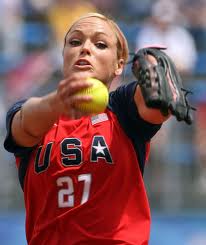
Jenny Finch dominated college softball. She pitched Arizona to a national championship, helped bring home Olympic gold and silver medals to the USA and spent the last eight years a vagabond carving out a life in the sport she loved. She ended helping the US win the World Championships this week. The Olympics, under pressure from Europe, banished softball  undercutting the infrastructure that kept softball athletes alive and competitive. With no real pro league, sporadic national and international events, softball players have no where to go. Jenny Finch is retiring at the age of 30.

I have been privileged to watch a magnificent softball athlete play for UW, Danielle Lawrie. She lead UW to a national title, played on Canada's Olympic team, won national player of the year twice and will graduate next year with a very uncertain sports future.

I cite these wondrous softball players as examples of true amateurs. Being an amateur is a way of being in athletics, not a legal category about whether you are "paid" for performance. These athletes do not play to get rich; they need money to live but live to play.

Like Finch they scramble around to get sponsors, find jobs  and lives that permit them to practice and compete. They have no guaranteed contracts, no high powered leagues, no unions and at best may make expenses or a reasonable living to compete, not be wealthy.

Most athletes who don't play in the pot of gold sports like football or basketball live as amateurs. All women athletes live in this older world not so riven by mercenary motives, but still driven by glory, achievement and love of the game. Finch could still say "I am still having fun," the day she retires.

Amateur derives from the Latin "amo"- to love. As a noun it literally means a lover--a lover of the game, the sport. Love complicates things. Lovers do irrational things because their relation to the sport brings them joy. Athletes love playing and competing in their sport.

Loving a sport brings joy and  satisfaction. Lovers work on what they love and love motivates them to get better. Love can grow into a compulsion if its desire consumes a person. Being in love can also be tortured, and more than a few athletes live out a tortured relation to their skills and achievements, loving and hating what they are driven to do. The love can also make it hard for them to carve out personal lives given how consuming their passion for their sport can be; it's hard to make room for two loves.

But love does not have to be tortured. Love can be fun and joyous, and great amateur athletes usually stay for the love and joy, not the torture. Love also brings heartache. If you are doing what you love and fail, it hurts all the more. It brings a pain of loss and failure far deeper than if you were just doing your job. Love also provides a wellspring to renew and recover. At the winter Olympics athletes like Lindsey Vonn and Askel Svindel demonstrated the will and strength to come back from body and career destroying injuries just to compete and win, not just bring home a paycheck.

This is why amateurs represent an old and deep ideal of sport. Athletes achieve from love, not just mercenary motives. Love and money are not incompatible.  Ancient Olympic, Chinese and Indian athletes fought for glory and prizes. They were well recompensed for their achievements in honor of their city, country or Lord. College sports and the world of national competitions creates an in between world of support but not riches for athletes. In college sport athletes receive education to last them after sport leaves their lives. They receive a community, travel and play and medical care and support and facilities. But not riches.

Money sustains love of sport because athletes need time to train and live.It enables athletes to raise families and have a life. Money matters because  athletic excellence flames for a brief moment of  supreme achievement then dampens from age. In the pot of gold sorts, money can become riches, but the riches themselves are fraught. Almost 60 percent of pro football players leave bankrupt after five years of their career.

Love sustains better than money. You can feel a job athlete a mile away, actually the entire NBA season feels that way. No joy, no love, more charade than sport.

Love moves us to do strange and wondrous things. Love fuses with athletic aspiration to drive millions of players to play at all levels of sport. It permeates club games (leaving aside AAU basketball) and can be found on courts and fields all over the world. Yeah, there are always yahoos who play only to prove their dominance. But it begins and endures with  the deeper love of game, love of skill and love of being with comrades.

Love is not enough. We all know that. Athletes need to train, live and many choose to have families and still try and hold it together. They need sustenance for this. Ironically the fact that most sports are not pot of gold sports keeps love alive.


Saturday, February 13, 2010

The Olympics and Nationalism

The Winter Olympics opens today. Pageantry, glory, promise, 800 plus hours of NBC TV on 5 channels, no snow and 30 athletes  disqualified so far for positive drug tests. I love the Olympic ideal and truly believe that athletics like art and science transcend cultural and national boundaries. The founders of the  modern Olympic movement dreamed that the Olympic peace (all the Greek city states agreed to stop their wars for the period of the competition) of the original Olympics would promote harmony and respect across nations rather than the realpolitik of endless competition and war.

Even as I enjoy the artistry and achievement of the Olympians, I remember that the athletes compete for themselves but are here for their country. In this world of vagabonds and mercenary athletes this is a time when athletes return to the womb and compete for their country. Lest we forget, they march in together and wear the same uniforms (can you imagine Ralph Lauren designing military uniforms?).

The original Olympics held a tenuous peace but that did not prevent a form of war by proxy in the Olympic games. Nor did it stop regular attempts to steal athletes from one city state to compete for another, just as modern Olympic citizenship can become rather porous.

This aspect of Olympic competition seems to grow from a collective egoism. As a citizen I identify with them not because of excellence but because they win; they conquer; they prove superior to everyone else (if you root for the Yankees you know what I'm talking about). The Olympic peace transforms, as it did in the original games, into a war by proxy; I prove my superiority over you as a person or country when my team beats your team. Hitler raised this to its most exalted insanity with his Berlin Olympics designed to showcase the superiority of the master race. Unfortunately Jesse Owens and the University of Washington crew team, among others, showed up and punctured the Swastika clad  propaganda staged Olympics. During the cold war years TV commentators breathlessly kept medal counts, kind of like the ballistic missile counts, to see whether the US or USSR would "win." (Now if you think about figure skating as an agent for the cold war, it does seem a little silly).

The Olympics also permits a form of assymmetric war to occur. Small countries or poor countries can invest alot in athletics or pick a few sports to excel in.  The most successful and tragic episode occurred with East Germany, a small state, the Prussian remnant of Germany occupied by the Russians at the end of World War II. The country made a concerted and secret effort to reinforce its identity and legitimacy through sports superiority. Young boys and girls were recruited at a very early age; sequestered in sports clubs and academies where they trained relentlessly. They lived in splendid and privileged isolation from the poor society at large. The kids were also fed a finely calibrated diet of "vitamins" to ensure their health. The steroids and hormones they ingested generated immense strength, more rigorous training because they bounced back faster and created prodigious human beings. For over 15 years East German men, but especially women, who looked like mutant Valkeries, dominated swimming, track and field and weight lifting. The whole state sponsored system was designed to prove the superiority of communism over capitalism. It provided a great counterpoint to the relative failure of West German athletes and offset the incredible West German economic and political success.

The Olympic and World medals piled up. Other countries noticed the inhuman physique of the athletes. The whole house of cards came down as drug testing got better and the East European communist system collapsed. The lingering results today are a group of men and women who against their knowledge were permanently injured, as were many of their children, by the experiments upon them in the name of garnering Olympic glory and stature for their country.

I will enjoy the athletes, ignore ice dancing but wallow in curling and laugh at the antics and spectacular innovations of snow boarding. But I will remember these are humans first, athletes second, citizens third. I will not let some atavistic glory in their relation to my country or other countries take away from the true glory of their achievments.