Showing posts with label practice changes. Show all posts

Thursday, July 10, 2014

Sports Ethics: Clean it Up

You hear it all the time. Losing at halftime or the end of a loss a coach will respond to the question, “what do you have to do better coach?” “We need to clean it up,” will come the answer. The answer makes a lot of sense to a coach and gives a focus for halftime discussions or practices between competitions. This approach defines a particular tactical approach to professional and athletic excellence that works in many but not all situations.


“Clean it up” carries strong assumptions about the nature of sports and professional achievement that are worth remembering. Clean it up focuses on the prior existence of form and technique.

To clean up actions refers to prior forms and techniques that players and coaches know and can practice to get a more exact fit between player intent and executions. This tactic presumes coaches and members of the team know what they should be doing. They have a plan, a schema and an approach—the problem lies not there but that players are not executing with required form and technique.  Individuals need more reflective discipline and focus in practice and finishing to clean it up.

“Clean it up” is central to a formalistic conception of professional and athletic excellence. The imperative depends upon the idea that a player and team have obligation to master the technique and form of their position and practice. It builds heavily upon a skill conception of sport that focuses upon teaching players to link perception, mind, body and emotions into the execution of complex, sometimes minuscule  expertise, and integrate them into a flowing performance.

This formalism in an almost Platonic way relies heavily upon knowledge of the proper form. The form should be able to trump conditions if executed well. It builds heavily upon the ability of individuals to use their trained and integrated memory to master multiple forms and techniques and practice them in a mindful manner until they become second nature. The intent flows as disciplined action.

Clean it up points to the profound mental and intellectual foundations of elite sport and professional achievement. Most often when a coach or player talks about cleaning it up he or she refers to either the need to eliminate sloppy play or mistakes or address holes in their technique of game.

Sloppy play and mistakes arise from an intellectual and emotional failure. Individuals know the proper form but executed it without full focus and speed. The individual failed to give full attention to the exactitude required by the technique. Their attention wandered or never focused. The sloppiness can also arise from lack of full effort; they go through the motions or fulfill the form but without speed and effort so that the opponent can anticipate and nullify the action.

Mistakes can arise from lack of attention and the player deploys the wrong technique rather than what is required. They misanalyse the requirements of the situation. Or they may act but fail to remember or fully achieve the technique. This may arise from the opponent’s own efforts to force a mistake or it may arise because the player has not practiced enough or with full attention. Or the player may be exhausted and beaten up and simply misses a signal or cannot get his or her body to act fast enough.

Beyond mistakes and sloppiness lies another type of failure—a player may have a hole in his or her game. Their knowledge or implementation may be flawed or unpracticed. The player may be young or new to the system or they may not have given full attention to film or practice. Whatever the cause, the opponents recognize this weakness and exploit it mercilessly. It may be something as simple that a player has not learned to disguise intent and telegraphs their action so that the opponent can expect and quash the action. Either way the player and team need to commit to more study and practice to rectify the predictable limitations in their technique.


At the same time cleaning it up carries a wider team implication. Teammates rely upon each other to execute well. Teammates act on the confidence that other team members will accomplish their tasks and execute at point x at time y. The entire coordinated effort of the team and the effectiveness of plans, schemes and plays unfolds with this reliance. The failure to execute not only manifests the player’s breakdown but ripples through the entire team and scheme. People get caught out of place or act as if an action occurred and it does not so teams get “blown coverages” or uncovered bases or unguarded players. Timing plays where passes are thrown to a point not a player break down. These collective breakdowns permit opponents to achieve their goals much easier and more efficiently. At worst other teammates get tentative in their own assignments and commitments because they no longer trust each other or the power of the system they execute. That mental and emotional hesitation becomes contagious and can undermine the entire team’s execution.

The demand to clean it up, however, has a basic limit. Cleaning it up is vital to elite execution, but it presumes that the scheme or system works, or would work if only properly executed. It remains a fundamentally tactical ethical position. It focuses upon precise assessment of actions but with a view to the ideal technique that should guide the action. The technique itself depends upon the larger scheme of action and the goals behind it.

Walking off a field at half time when a coach says “we have to clean things up,” the coach is giving a vote of confidence to the game plan and to the schemes. He or she is also giving a vote of confidence to the intellectual talent and discipline of players. This comment assumes the players, once they understand where they failed to execute, will adapt and execute with precision and impact.

If, however, the opponents simply outclass or outthink the team, then no amount of cleaning up the play will help. The very goals that the techniques and form support will be undermined either by the approach, the strategy or the sheer talent of the other side.

“Let’s clean it up,” drives people to focus upon the form and technique of their profession. It drives folks to practice and internalize the methods required to pursue the goals. Beyond the method lies the coordination and communication the team relies upon to ensure that each person’s execution of a clean and precise action integrates with the planned anticipation and actions of teammates.

Form without context can create beauty but not impact. So "cleaning it up" only starts the process with oneself and learning. Real cleaning it up to be impactful involves players combining and syncing their techniques and actions to present a seamless appearance. But this seamless front hides the  endless minute adaptations of technique and form to accommodate opponent's innovationsand the needs of the moment.

If a coach and team have the wrong strategy, no amount of cleaning it up will help.


As long as the strategic goal makes sense, cleaning it up makes sense. As long as players communicate and coordinate cleaning it up makes sense. If either fails, cleaning it up only means the defeat will have proper form.

Friday, August 23, 2013

Sport Ethics: "Be Smooth"

I watched a amazing double play last night and marveled at how seamless and flowing the entire coordinated action was. The integrated flowing precision of the play while adapting on the fly reminded me of how important being efficient and flowing can be to sports achievement. When he spoke to the media for the first time in six months, the Seattle Seahawks powerful half-back Marshawn Lynch was asked how he felt. The man known for "beast mode" running over people, simply responded, "smooth," capturing a powerful insight into how strength matters little unless allies with form and efficiency.

In an ESPN Magazine article Aaron Rodgers described the result of his endless repetitions in his off seasons as well as how he has grown over the last five years. He reiterated that what he achieved was to be smooth. Smooth captures an interesting and vital concept when thinking about athletic and professional accomplishment. I would like to explore its nature and importance.

Smooth is the anti-thesis of turbulent and chaotic. Hitching, jerking, choking, hesitating and waste stand opposite of smooth. Smooth actions maximize outcome for energy expended. Smooth operations epitomize efficient energy deployment, a smooth action simply does not waste motion or energy so it maximizes quickness and execution consistency. Being smooth represents integrity of action and judgment expressed as expertise.

Smooth encompasses two domains: physical and mental. First, extra or needless motion slows down action and exposes players to greater disruption. The more complex and less integrated the motion, the less smooth and the greater the probability things will go wrong. Smooth physical action minimizes inconsistencies in performance and requires the least energy because no extraneous motion occurs. Smooth action permits the body to bring maximum energy to bear upon the movement and because it is smooth, it increases the consistency of action and results. 

Second, smooth actions flow from integrated decisions that adjust to the situation and deploy technique in face of unpredictability. These decisions proceed without hesitation or second-guessing because the person represents the pattern emerging in the situation and responds cognitively. This minimizes openings that  opponents can disrupt. As actions grow into a single, fluid motion, they minimize what can go wrong and minimize the profile to be attacked by an opponent.

Rodgers talked about the micro-adjustments he made over the years such as footwork, arm angle, release point. Each evolved, but more importantly, over time these changes coordinated with each other and then integrated. He learned to release faster and more accurately under attack. This hard earned smoothness minimizes friction which  maximizes  predictability in his suite of skills and confidence to employ them. Repetition, continuous learning and adjustment resulted in coherent dependability.

If you watch a beginning athlete or a beginning anything, she or he moves very cautiously. Often they master one skill at a time in sequence. They then try to connect them together. Their actions hesitate, jerk and seldom link together well  or the same way each time. Each action becomes an adventure with little reliability or confidence.

Athletes and professionals master small aspects and then mesh them together. Tennis and volleyball players practice tosses thousands of time before a consistent serve emerges. Then they work on swing, angles and release points. Most important they learn to translate lower body strength into explosive energy. I could break down any athletic or professional skill suite this way. To achieve smooth integration of a skill suite involves committed discipline and practice.

SMOOTH requires integration of skills and synchronization with context to achieve. It requires endless practice and refinement. Social psychologists talk about the idea of flow that I have often mentioned. In flow, an athlete has prepared so that the kinesthetic, intellectual and perceptual dimensions of suite of actions flow together. Actions possess a rhythm and resonance where the athlete precisely repeats what works and can slow down the world as they act.

Each motion and skill involves thousands of micro-skills and adjustments. These must be mastered and blended into a master action suite. This action must then coordinate with fellow teammates or adjust to conditions. Think of a rower in eights. The angle of repose changes as the wind or place in race changes. The angle of one’s wrist, shoulders, elbows and back and legs must all be monitored, coordinated and then adjusted on the fly. From a distance it looks beautiful and powerful, but each sweep, like each Aaron Rodgers' throw or Albert Pujols' swing requires incessant monitoring, adjusting and fusion of perception, power and form.

Dave  Cameron discusses this in terms of kinetic chain or transfer and the importance of efficient and effective energy impact maximization. This involves mindful practice, refinement and adjustment. Talking about a baseball swing he points that that actions look smooth because there is a proper transfer of energy as it flows through a chain. The energy flow is close to seamless from one step to another. Any movement that siphons energy away from the kinetic energy in the chain of action will diminish the energy output of the bat or action. Put simply this swing analogy applies to all professional actions:


Swing energy = Total energy - Energy lost to excess movement and bad timing.

Even more simply:
Smooth is good; herky-jerky is bad.
When you listen to scorers, they will sometimes complain of a “hitch” that subverts their shot. Other times they might talk about how they had to hurry a shot, and to hurry means they could not synchronize in adjusting and executing. The hitch or jerk induced or self-inflicted subverts smooth. It upsets reliability, induces tweaking and over-thinking and can undermine confidence. Opponents will try to hurry or disturb rhythm or fluid motion to throw off the skill and the mind of athletes.

Being smooth in executions means that practice and experience reinforce each other. Mindful repetition enhances the integration and etches the neural pathways that support habitual and instant action as well as refined decision making under pressure. Experience builds psychological, physical and memory capital for a person. It builds a mental toughness flowing from “I have seen this before, so my body and mind do not panic.” Internalized experience supports smooth action because athletes don’t panic or choke in face of surprise or opposition; like good professional they adapt and call upon extra energy and focus to stabilize emotions and perceptions that permit focus upon actions. Every pick and roll or double play embodies unique aspects but great teamwork makes it all look smooth.

Smoothness reveals “thought-less” expertise. The repetition and adjustments from game to game and season to season mean athletes and professionals constantly must learn. The learning results in refined skill and adjustment. Athletes improve  proficiency as well as decision-making. The learning manifests as reliable performance under stress. 

People compliment actions by calling it a  “smooth operation.” They seem to mean something went off without a hitch, notice that word again. They often refer to the actions relative to a plan, like a litigation strategy or football play. However, we seldom really mean an operation that went off exactly according to plan. The old truism “no plan survives contact with reality” carries real weight.

We need to distinguish between an operation going exactly according to plan and one that achieves its outcomes. In reality, the plan condenses to a direction or momentum, but not an exact rendition of what unfolds. Outcome based “smooth” means well trained and experienced athletes and professionals improvise, adapt and achieve outcomes within the plan’s goals. It looks smooth because their actions seem fluid and continuous with the goal even as they must perceive, process information and make new decisions constantly and seamlessly.

A smooth operation achieved its goals by executing but also adapting in countless micro decisions to small and unexpected obstacles or surprises. The individuals and team worked together kept their cool and achieved the outcomes with practiced efficiency. In smooth success, small things matter and the hours of practice to orchestrate internally and externally come together.

Good athletes, good teams, good professionals make it look easy, make it look smooth, but it never is.


Thursday, September 9, 2010

Achilles Revenge III: Change the Games

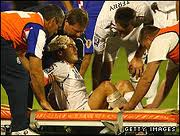
The new knowledge about damage to brains and self is too great. The cost to the personality of players over the long run is too great. The excuses to not change illusions. We need to change the rules of the footballs to protect the integrity of the game and the integrity of the players.

I am no expert and certainly have no panaceas, but I will suggest a few modest proposals to start the discussions. Remember, last year 300,000 concussions were reported in football alone. Other reports estimate that over 50 percent of the concussions go unreported and less than half the high school programs have trainers at games. I will focus upon American football, but we could look lots of areas. For instance, the level of concussions and brain trauma is rising in basketball. The main reason is that the players are too big for the size of court. Trying to drive on the old court amid the huge bodies leads to immense shoving, bumping, falling and head injuries. The answer would be simple: increase the size of the court to unclog the middle.

The key to addressing the brain trauma is to remember that it is the repetitive impact that matters. The persistent rattling of the brain generates the problems, not sudden traumatic impacts. The most immediate response has been to diagnose and get players out of the game when concussions occurs, but by then it is too late and does not address the aggregate impact. The changes need to be pervasive.

The first place to start would be practice. Alot of football practice can occur without hitting. The number of injuries in practice can rival those in games. In modern football, more and more time is needed in the classroom and mental preparation. Practices could occur that do not require helmets and head contact. Contact can be limited to body, not head. You could easily reduce head contact practices by 30 to 40 percent. Players would still internalize the knowledge and skills; they would still develop toughness and still have ample time to maim each other, but it would be more limited. This would especially help in the unregulated world of high school and club sports.

The second place is to get the player out of the game when an injury occurs. The NCAA has proposed changes to mandate much more aggressive testing of head trauma  during football and soccer games. The trainers and doctors must  be mandated to take a player out who presents trauma.  A new array of diagnostic tools are available to diagnose concussions definitively beyond pushing fingers in front of a player and asking them to count. This means moving away from the ethos that helped kill Lou Gehrig, "rub some dirt on it and get back in the game." Players will play hurt to prove themselves, to be loyal to their team; to live up to an image of being a warrior. The only way to stop this is take the decision away from the player and away from the coach. The coach has too much invested in keeping good players, even injured good players in the game. Many good coaches have played injured and expect this from their "warriors." 

The third place involves rule changes. I don't know rules enough, but changes in stances and blocking could limit the continuous exposure of heads on the linemen who face the most persistent brain pounding. The stance changes would change offenses, but nothing that would kill or destroy the game as we know it. Tweaks on the rules and more aggressive enforcement and penalties of spearing and head to head contact are already involving.

Finally we need to look at technologies and be willing to pay the cost. Ironically the emergence of modern technology has weaponized the human body in football. Wearing kelvar jackets, huge shoulder pads, helmets with eye shields dehumanize both the player and the opponent. The uniforms look like Halo warriors and encourage  a sense of invincibility among players. Efforts have been made to address heading in soccer but nothing so far reveals real protection. But in football we know better helmets can make a huge difference. Military technology and helmets have made immense strides under the pressure of CTE in Iraq. None of this is incorporated in the plastic technology in football helmets. The NFL can put in microphones, but not head protection. Cost stands in the way, just as it did when the NFL and NCAA pretended there was not a brain trauma problem. Things as simple as  mandating new mouthguards that  diffuse kinetic energy from hits in football can help. 

Purists, who don't play and don't risk permanent brain damage or ALS, will scream about diluting the game. They will talk about how we are sissyfying the game and taking away the courage and skill, somehow cheapening the game by limiting the risk. Let them. But they will not be the ones in their forties and fifties with reduced brain capacity and loss of identity. This is serious and it does cut at the heart of the game, a game of mind and organized violence. But the game relies upon the mind first which directs and organizes the violence.

These are the beginnings, but players associations, unions, doctors and the NCAA along with the intrepid reporters who have kept the NFL's feet to the fire need to keep up the drum beats. The NFL's answer to all this. Increase the number of games played! In the second week of play Stewart Bradley collapsed in front of 28 million FOX TV viewers clearly hurt; four minutes later the Eagles' coaching staff pushed him back into the game. Finally at the half he was diagnosed with a concussion, something anyone watching could see. The NFL can make public service announcements, but all the logics push them to play injured players unless they change the game.

The changes will face four challenges. The biggest will be money and the resistance of pro and college teams to spending the money on new technologies. The second will be the resistance of young gifted players at the prime of their physical and mental ability. They will resist feeling diminished in their warriorhood by practicing less or wearing new "sissy" technologies all of which aim to protect them when they are 50, but hard to figure when they are 22. Third, coaches, many of whom played and made it through without brain damage, will resist for the degradation on playing excellence that limitations on practices and stances or hits will impose on them. They will hate giving up control over keeping talented players in the game. Fourth the media networks will silently resist it as will their shills in the booth because they make money off the violence. Networks love the hits and terrifying moments when the stands hush and a player lies motionless, perhaps injured for life. Just as NASCAR  is addicted to crashes and hockey to fights, networks are addicted to ultra violence, not the beauty and intellectual chess and physical and mental adaptation players demonstrate.

All the opposition should be overriden. The press of the immediate gain, the press of mantaining an image of invincibility to yourself and the press of wanting the best players on the field  will prevent the on field actors from from taking the long term view about crippling effects that will occur long after the players have moved on.

We need to change the rules to protect the players from the game. In doing so we will remember these are games of humans,   not sacrificial pyres for humans.